Multi-channel intake
Clients complete intake via WhatsApp or USSD. No smartphone or internet required.
Clients complete intake via WhatsApp or USSD. No smartphone or internet required.
A deterministic rule engine maps each client profile to WHO eligibility categories before any recommendation is made.
Retrieval from Kenya MOH guidelines and WHO publications grounds every recommendation in cited, vetted guidance.
Community health workers review, counsel, and confirm every client choice. ChaguoAI supports, it does not prescribe.
Four interfaces. One coordinated care workflow.
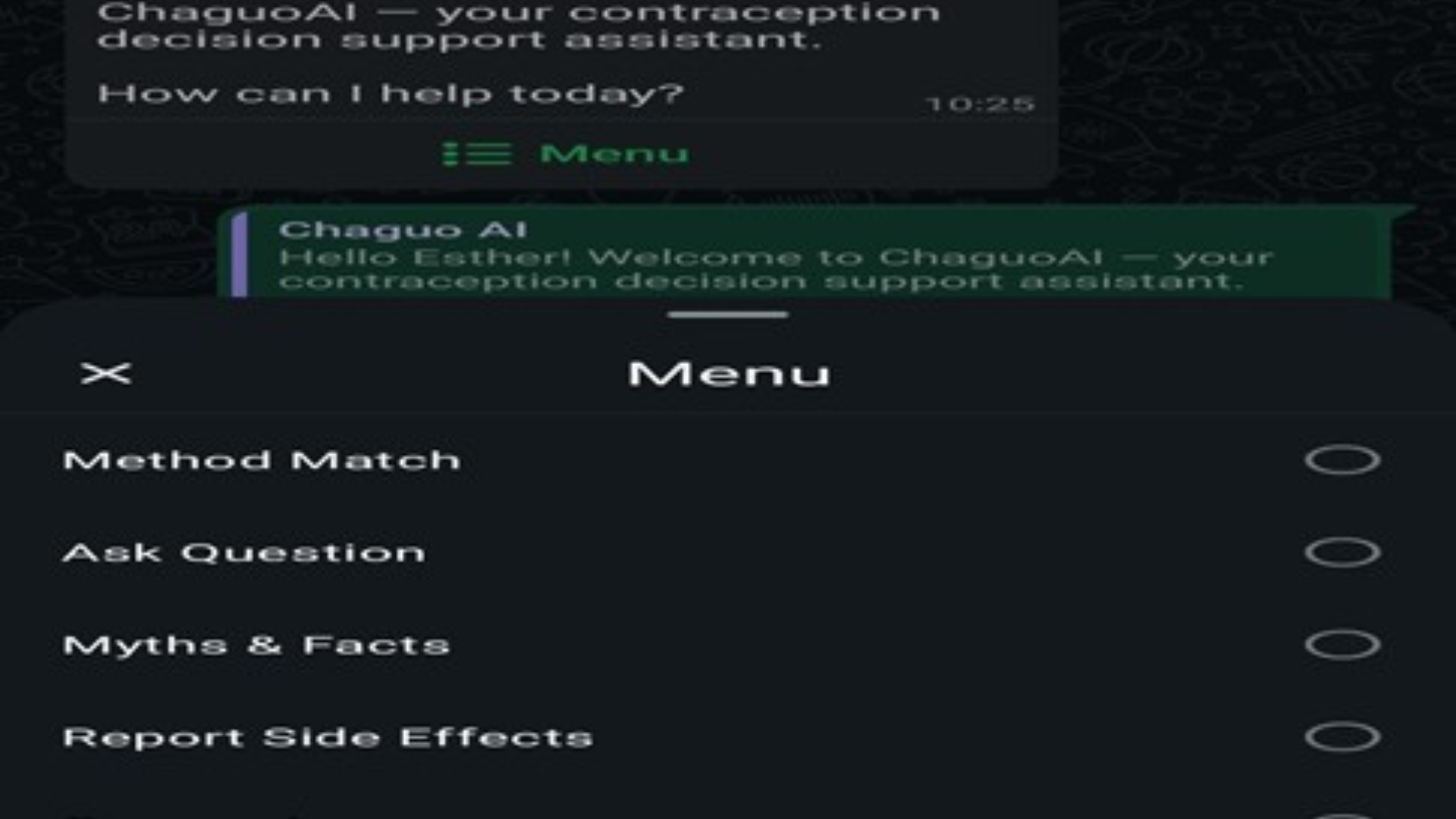
Clients initiate a structured intake conversation through WhatsApp. The system collects age, parity, medical history flags, and method preferences across multiple turns. Responses are generated in plain language grounded in Kenya MOH guidelines. No app download required.
Request a walkthrough of the live system with our team.
Request a demo| Layer | What it does |
|---|---|
| Safety layer | Applies WHO Medical Eligibility Criteria as fixed clinical rules before anything else runs. Nothing unsafe can be recommended. |
| Knowledge layer | Retrieves the relevant passages from Kenya MOH and WHO guidance so every answer is traceable to a vetted source. |
| Language layer | Turns the clinical result into plain, respectful language in the client's own language and reading level. |
| Risk layer | Estimates the likelihood of discontinuing a method within 12 months, as an advisory annotation for the health worker only. |
| Channel layer | Delivers the conversation over WhatsApp and USSD so clients need neither a smartphone nor a data bundle. |
| Service layer | Handles queuing, storage, audit logging, and provider workflows behind the scenes. |
The ML model was trained on 78,000+ anonymised family planning programme records from Siaya and Busia counties in Western Kenya, sourced from the DASSA platform under the HASH Innovation Challenge. It predicts 12-month discontinuation risk with an AUC-ROC of 0.903 and an Expected Calibration Error of 0.005. The model annotates recommendation packets in shadow mode only. WHO MEC eligibility rules always take precedence. Clinical safety is never ML-determined.
Architecture, evaluation methodology, and model cards are documented in our technical report. Implementation detail is shared with funders, clinical reviewers, and research partners under agreement.
Technical Report
Read the full methodologyOpen Source
Repository coming soonReproducibility Package
Reproduce our ML results